
In borrowed clothes
The torpedoing of the SS Athenia - Part 5

A warm welcome to new subscribers to This Writing Life. This first post you’ll come across is usually a perk for paying subscribers to thank them for making it possible for me to keep writing stories, but for now I’m trying something different. Because I’d like this fascinating story, which will make the basis for novel number three, to reach more readers, I will leave it open for everyone to read for one week from publication.
My aim is to post these essays once month, but because life sometimes gets in the way, both of writing and reading, let’s start with a recap in chronological order, or, if you’re all up to date, you can scroll down to skip to the next part of the story:


…OR IN SHORT
On 3rd September 1939, the British Prime Minster Neville Chamberlain declared war on Germany. That same evening the German U-boat U-30 fired a torpedo at the British passenger ship SS Athenia which was on route from Liverpool to Montreal, bringing home many American and Canadian passengers who had wished to escape the threat of war over Britain. This torpedo, as it bulleted through the water towards the ship, not only represented the first shot of World War II in the west, but it also ignited The Battle of the Atlantic. At least this is the story told so far on a global scale, while on a personal level, my grandmother-in-law, Ruth, had just been rescued by the destroyer Escort, after having spent nine hours bobbing on the high seas in life boat number 3.
The frantic worry of not knowing who had survived and who had perished
During the chaos of boarding the lifeboats families, friends and travelling companions lost sight of each other. Some were aware that their loved ones had boarded a different lifeboat, others had not seen theirs since before the torpedo exploded and these survivors had no way of knowing whether their children, parents, spouses, friends had been killed or survived.
More passengers were lost during the perilous rescue operation when two lifeboats capsized, even with one woman throwing herself into the sea after she realised her baby had been lost.
In terms of the rescue ships, there were four: SS City of Flint (with passengers transferred from Southern Cross, because this luxury yacht wasn’t equipped to cater for hundreds of passengers) which was steaming across the Atlantic towards Nova Scotia in Canada; Knut Nelson going to Galway in Ireland; the destroyers Electra and Escort heading towards Glasgow. This dispersion of survivors meant it would be over a week before they’d find out for sure who had survived and who had perished. On these ships were parents missing children and children missing parents:
One puzzle was that of a baby girl without her parents. Those looking after her could not quite make out what she called herself. It sounded like she said Rose Marie Caspicks, possibly from Oxford. Her desperate parents in Glasgow could figure it out, however: she was Rosemary Cass-Beggs, and they were the only family on board the Athenia from Oxford. She had been carefully looked after in the lifeboat, on the Southern Cross, and now on the City of Flint by Mrs. Winifred Davidson of Winnipeg. The Cass-Beggs cabled friends in Canada to meet the City of Flint and baby Rosemary in Halifax.1
Because Athenia’s passengers had boarded in the three different cities of Glasgow, Belfast and Liverpool, this also meant that the Donaldson Line was struggling to put together an accurate passenger list.
On the one hand we have the relief of survival after the horror of the cold night in the lifeboats on the open seas, and on the other hand we have survivors being sick with worry over not knowing who was safe and who had perished at sea.
City of Flint goes to Nova Scotia in Canada
The first rescued passenger to board City of Flint was ironically a German. The passengers were welcomed by Captain Gainard and sent to get dried off and cleaned up. Many were covered in fuel oil from the explosion as well as drenched in seawater and in their nightclothes or even only half-clothed. Several were so distraught they were crying, but on the whole great relief was felt at having boarded an American ship.
The ship itself was a merchant ship, which had neither the equipment nor the provisions to accommodate the 236 survivors it had picked up. Passengers were soon set to work to build berths, and to help with cooking and clearing up and the general day-to-day running of accommodating so many people. Sailors gave up what clothing they could and made sandals out of ropes and cloth for the survivors.
The journey back on City of Flint was traumatic though. Many survivors kept their clothes on at night wanting to be prepared should there be another submarine attack. They jumped at loud noises and the deteriorating weather leading to violent movement of the ship made them fearful. When the lighting system went out at one point people screamed and children started to cry.
But there were highlights too, a children’s birthday party which cook managed to bake a cake for, and a fashion show arranged by some Texas college girls where the survivors strolled up and down showing off their makeshift clothing, such as sailors’ dungarees, blankets and handmade rope sandals.
Below is a video that contains first a spoiler, of how the survivors taken to Glasgow eventually returned home, but after that there’s a clip about City of Flint.
Knute Nelson goes to Galway in Ireland
Galway in Ireland opened its arms to receive the survivors off the Knute Nelson. The mayor, the town clerk and the Catholic bishop formed a committee to work with the council and health departments to look after the survivors. The mayor’s wife got a group of women together, as well as the Girl Guides, to volunteer. Food, clothing and medical care was to be provided, and the local school was made available.
When Knute Nelson pulled into Galway a great cheer went up among the survivors and many wept openly. Ten survivors were so seriously injured that they had to be carried off the ship on stretchers. People were still in a state of shock and children were crying for their parents, and even though the whole town of Galway had come out to meet the ship with a sense of joy, that soon changed shock at the bedraggled state of the survivors in their borrowed clothes.
Once on land the survivors were given a cup of Bovril as well as butter and bread. Then the registration began in order to begin to untangle this question that the entire western world was waiting for an answer to, of who had survived the sinking and who hadn’t.
Once registration was completed the survivors were taken on buses into the hotels and homes where they’d be able to stay until transport home could be arranged - Galway truly opened its arms to these distressed survivors.
Escort and Electra go to Greenock in Scotland
The night on the two destroyers was not uneventful. Especially after these two ships had sounded alarm bells and dropped depth chargers on what the crew thought was a submarine. These actions frightened the survivors who were already in a high state of anxiety.
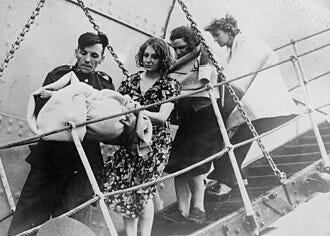
The destroyers were heading towards Glasgow, but the fog on the Clyde was so thick that the ships had to pull into Greenock instead, a town several miles away from Glasgow along the river. The survivors made their way down the gangway, again in borrowed clothes, and many with burns, broken limbs, severe bruising, and here as well were children in distress crying for missing parents and siblings. Each person was registered as they left the ship, adding more pieces to the puzzle as to who had survived and who had been lost.
In Greenock no preparations had been made to receive the survivors due to the sudden change of course. They were only met by dock workers, who shared their food with them. One of these workers went into town to get cigarettes where he told his wife of the arrival of the survivors. Word spread and within moments wives of the dockworkers streamed in carrying all manner of garments.
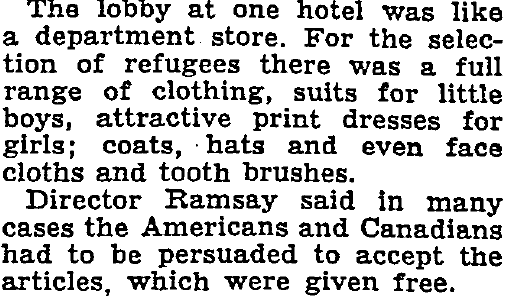
Later that morning, the buses that had been arranged to pick up the survivors at Glasgow arrived at Greenock to take them into town, to hotels where they were given food, toiletries, money and clothes from a local clothing store.
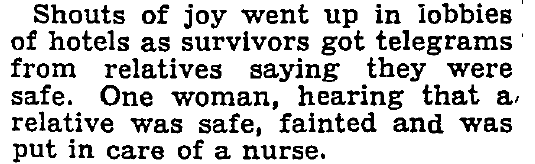
This was also the first chance for the survivors to send telegrams and receive news of family members.
Politically, the question remained of what had actually happened to cause the Athenia to sink? Who had fired the torpedo? To determine this affidavits were taken from all the survivors, and it gradually became clear that the torpedo had, in all likelihood, been fired by a German submarine. Germany denied all involvement and tried to pass the blame onto Churchill, claiming it was an act by him to persuade America to abandon their neutral status and join the war on the side of Britain.
There was also the question of how to get the survivors home, and what official could take responsibility for them seeing as the embassy and consular staffs were already up to their necks in dealing with Americans wanting to leave Britain after the outbreak of war. The American ambassador to Britain found a solution:
[He] sent his twenty-two-year-old son, John F. Kennedy, up to Glasgow on the night train to represent him and to assure the survivors that the American government was concerned about them and would see that they got home to the United States. Young “Jack” Kennedy had been given leave from Harvard to join his parents in the spring of 1939 and he had spent the summer travelling extensively in Europe, visiting many of the places that were at the very centre of the War crisis, and returning to London just as the war broke out.2
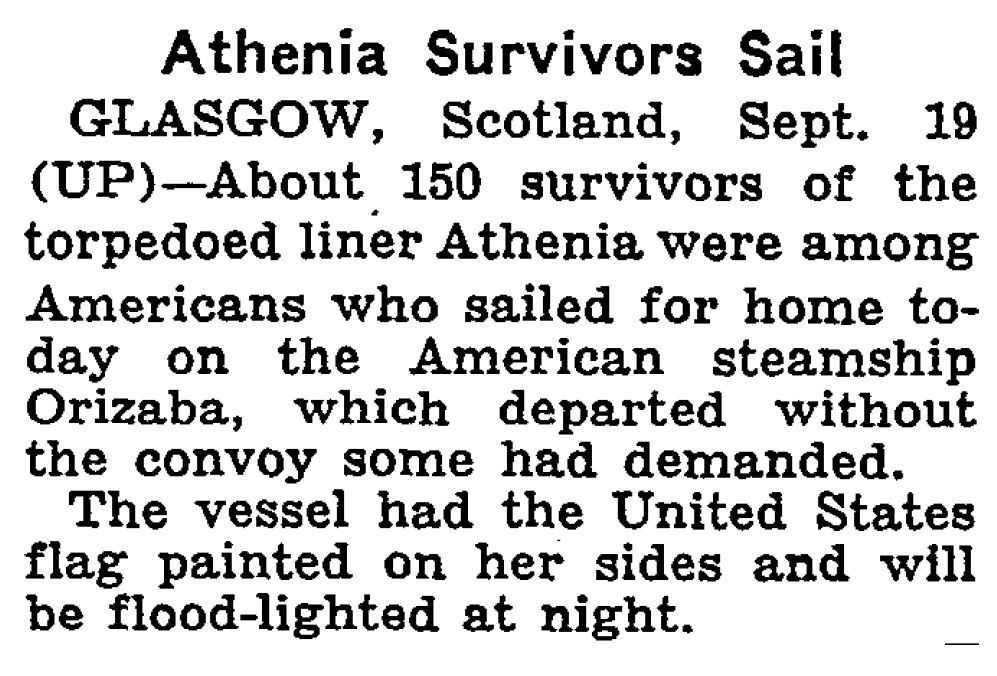
It then became the responsibility of a very young JFK to break the news to the survivors that they’d have to return to America on a ship without any kind of escort. Needless to say this caused great anxiety among the survivors who had already been torpedoed once, and especially now that war had fully broken out, which hadn’t been the case when they’d first boarded the SS Athenia. Kennedy tried to reassure them that they would be safe because of America’s neutral status and this would be shown by having the American flag painted on the ship, and the ship itself would be fully illuminated at night. The survivors protested.
“Ninety destroyers have just been commissioned by the United States Navy and surely they can spare us a few.” Someone else claimed that “two years ago the whole Pacific fleet was sent out for one woman (Amelia Earhart).” One of the young women stated, “We defiantly refuse to go until we have a convoy. You have seen what they will do to us.” Gladys Strain, the organizer for the Texas college girls, declared, “We can’t go through that again,” and many women agreed.3
And yet this is exactly what happened, the Orizaba picked up the survivors and took them to New York where they were left to rebuild their lives after this deeply traumatic experience during which many had lost close family members and all of them had lost everything they’d brought with them.
I leave you once more with Ruth describing the experience in her own words. Sadly it turned out that Margaret’s parents were not among the survivors.
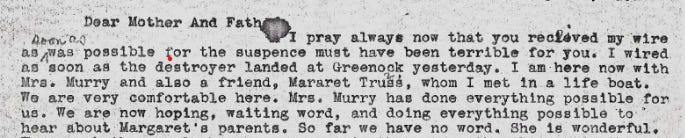
As I’m making this post free for a week, I’m including some ways to support me below. I write these articles out of a love for the craft and a fascination with this story. But neither love nor fascination will put food on the table, so if you’ve enjoyed this article, please consider upgrading your subscription.
Or if you’re unable to commit to a subscription, buying me a coffee would help fund my work.
My novel The Shape of Guilt is available to buy with free delivery from Blackwell’s in the UK or from Barnes & Noble in the States, and if you’re a Swedish speaker you can find out more about where to buy my Swedish children’s books here. Or you can leave a review of The Shape of Guilt here. And finally, here’s a tip jar.
Page 101, Athenia Torpedoed, Francis M Caroll, 2012, Pen & Sword Maritime, Barnsley
Page 88, Athenia Torpedoed, Francis M Caroll, 2012, Pen & Sword Maritime, Barnsley
Page 88, Athenia Torpedoed, Francis M Caroll, 2012, Pen & Sword Maritime, Barnsley
What a fascinating read, Lisa. Having the source materials must feel amazing. And a horrific experience for all involved. War is awful 😞